My Site
  • ON THE GO!
  • THE EXPERIENCE

Day 83 -> Zeppelins

8/11/2013

0 Comments

 
 Imagem
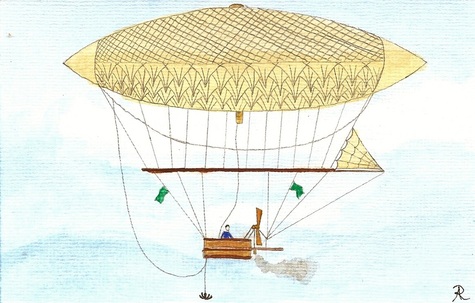
Giffard's Airship (Painting by Me)
     Heights were never my forte. I'm really tiny and not a big fan or airplanes or bungee jumps, though I've experienced both. However, I adore Zeppelins (the band too, but the aircrafts more). They bring me that cool and comfy nostalgic feeling - except whenever I read about Hindenburg - and I wish I could fly in one of them. So, today, I'll write a little about their history!
     The first Zeppelin was created in 1852 in France, by the steam technician Henri Giffard. It had 43m length, was propelled by a 3 hp steam engine that triggered a helix of 3,5m diameter. It reached the speed of 8km/h and flew about 25km before landing. Later, engineers noticed that, to become more functional, Zeppelins needed gasolin engines and a light aluminum alloy, which were developed in the 1880 decade. It was also understood that the power of elevation of the machine, which depended on the gas volume, would be improved if its length dimensions were increased.
    Gathering all these elements, the count Ferdinand von Zeppelin (were the popular name comes from) built his flying machine. The prototype, completed in 1900, was a cilinder of 128m with an aluminon frame coated with a cotton web. It could put up 11.320 cubic meters of hidrogen in 17 leakproof bags and was moved by two Daimler engines of 14 hp.
   During the first World War, Zeppelins were used in the first airstrikes in History, dropping bombs over London. Airship travels were in fashion in 30's - small groups of privileged people were taken from capital to capital and even across the Atlantic! The Zeppelin models back then exceeded 240m length. Sadly, when accidents happened, they tended to have great proportions, usually killing all passengers and crew.
~Ally
0 Comments

Day 82 -> Draco... But not Malfoy

8/10/2013

0 Comments

 
 Imagem
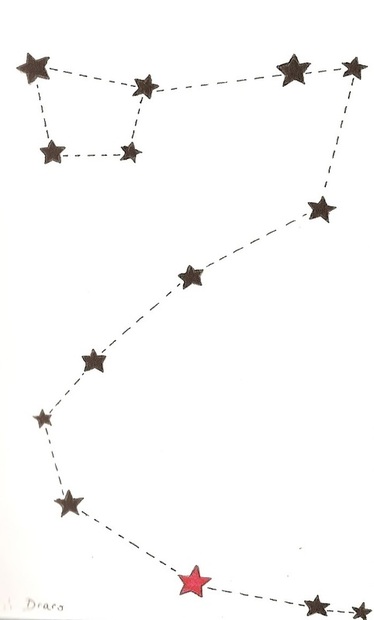
Draco (Drawing by Me - sorry about the crappy scan below)
    Despite being the eighth-largest constellation, Draco, the constellation of the Dragon, is not especially prominent (its stars are not very bright, but five of them have known planets). It never sets below the horizon and is always visible in the Northern Hemisphere (remember circumpolarity?). The name is derived from the Latin term "draconem", meaning "huge serpent," and the constellation literally snakes its way through the northern sky.
    The head of the dragon consists of four stars (Beta, Gamma, Nu, and Xi Draconis) in a trapezoid and located just north of the Hercules constellation. From there, the dragon's body winds its way through the sky, ending between the Ursa Major and Ursa Minor.
    The name Draco has been linked to several dragons in Greek mythology. One version is that Cadmus, the brother of Europa who was brought to Crete by Zeus in the form of a bull, slayed the dragon Draco in his quest to find his sister. In another account,  the goddess Athena took Draco by the tail and put it into the sky during the battle for Mount Olympus. Draco has also been identified in early Christianity as the serpent that tempted Eve in the Garden of Eden.
~Ally
0 Comments

Day 81 -> Ursa Minor

8/9/2013

0 Comments

 
 Imagem
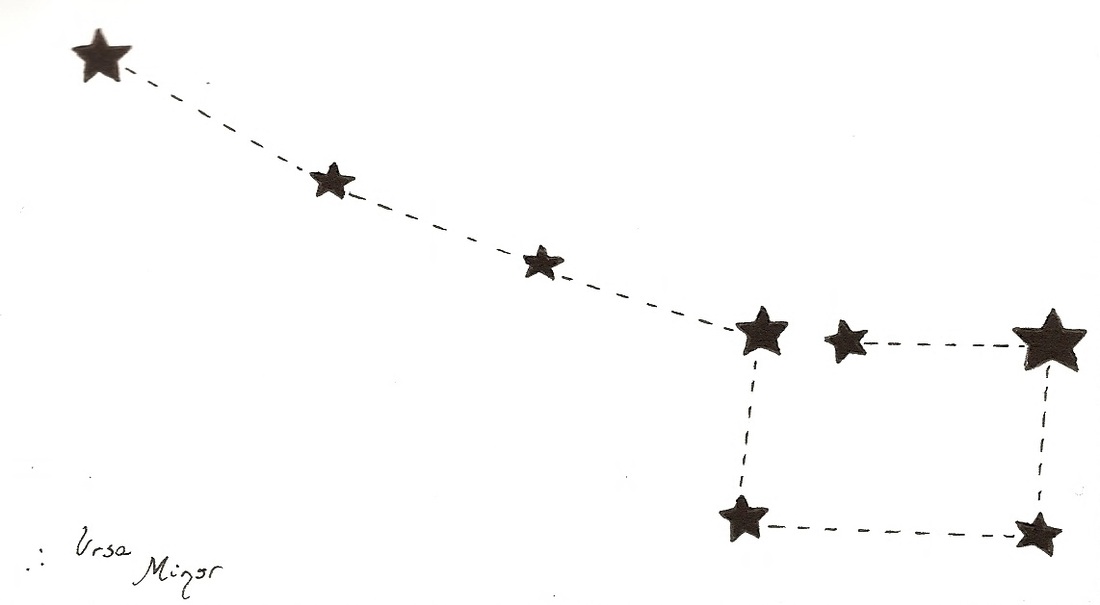
The Ursa Minor (Drawing by Me)
      The Ursa Minor constellation, also called Little Dipper, is commonly visualized as a baby bear with an unusually long tail. As I said yesterday, Ursa Minor and Ursa Major were related by the Greeks to the myth of Callisto and Arcas (who was Callisto's daughter with Zeus). However, in a variant of the story, in which it is Boötes that represents Arcas, Ursa Minor represents a dog. This is the older tradition, which could explain both the length of the tail and the obsolete alternate name of Cynosura (the dog's tail) for Polaris, the North Star.
      Previously, Ursa Minor was considered just seven close stars, mythologically regarded as sisters. In early Greek mythology, the seven stars of the Little Dipper were the Hesperides, daughters of Atlas. Together with the nearby constellations of Boötes, Ursa Major, and Draco, it may have formed the origin of the myth of the apples of the Hesperides, which forms part of the Labours of Hercules. Ursa Minor with its modern associations was invented by Thales of Miletus in approximately 600 BCE, from what had previously represented the wings of Draco, the Dragon. He did so out of a desire to commemorate the location of the North Celestial Pole, then near Beta and Gamma Ursae Minoris.
    In Hungarian mythology, though, the constellation is called 'Little Goncol cart' (Göncöl szekér) after a legendary shaman (Ursa Major is 'Big Goncol cart'). The shaman's knowledge knew no limit. He invented the cart: his nation was wandering, so the cart was the biggest gift of the Gods to the country. Legends claim he knew everything about the world. Nobody saw his death; his body simply disappeared among the stars.
~Ally
0 Comments

Day 80 -> The Ursa Major

8/8/2013

0 Comments

 
 Imagem
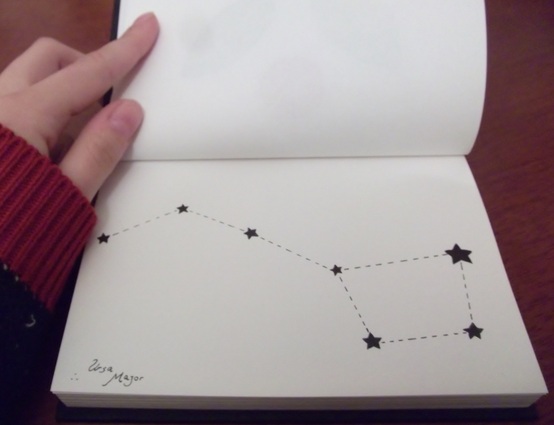
Ursa Major (Drawing and Photo by Me)
      I was never an amateur astronomer. Neither had a telescope whilst growing up. But, sometimes, I do like to gaze upon the night sky and try to figure out as many constellations as I can. Sadly, though, I only know two: Orion and Crux (which were I live is also called Southern Cross). So let us proceed to today's amusing knowledge!
      Before anyone say anything about it, I do know that Ursa Major is a northern hemisphere constellation. Nevertheless, I find it very interesting and decided to get to know it a little bit better. It is formed by seven shiny stars, which draw a square and a tail (I've never seen bears with long tails, but wha-te-ver). This figure, however, is called an asterism, meaning a characteristic group that doesn't constitute a constellation, since the real one is much bigger, including about 200 more stars. The Ursa Major is visible in the nights of almost all northern hemisphere, also being called the Circumpolar Constellation, but it's easier to be seen from January to October, when it is not so close to the horizon.
    This constellation is so famous that many ancient civilizations gave it meaning: for the Cherokee Indians, the stars represented seven hunters chasing a bear since the beginning of Spring until the Fall; the Brittish considered it King Arthur's chariot, moved by two horses; the Chinese said it was a shell that offered food in times of hunger; for the Egiptians those stars represented imortality, since they're visible all year; the Hebrews also saw a shell that measured cereal amounts; and I believe everyone knows the legend of Zeus and the nymph Calisto (who became the Ursa Major herself) from the Greeks.
~Ally
0 Comments

Day 79 -> Heads or Tails in Big Dead-Locks

8/7/2013

0 Comments

 
 Imagem
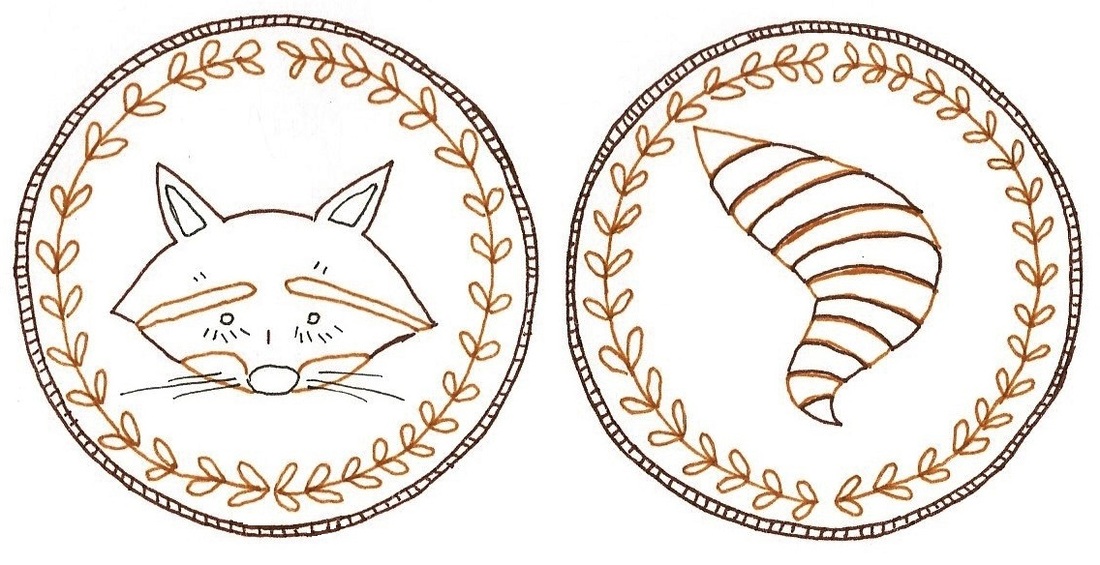
A raccoon coin, just because regular coins are usually boring (Drawing by Me)
      In the year of 1845, in the USA, Asa lovejoy and Francis Pettygrove threw a coin to decide who should choose the name of a new city in the state of Oregon. Mr. Pettygrove won and dubbed the city Portland.
      I'm used to see big decisions being taken by a coin's flip when it comes to Harvey Dent, a.k.a. Two-Face, from the Batman series. But it's interesting to know that real people also used the "heads or tails"method to decide some important stuff. Not matters of life and death, obviously, but you get the point.
~Ally
0 Comments

Day 78 -> The origin of Blind Man's Buff

8/7/2013

0 Comments

 
 Imagem
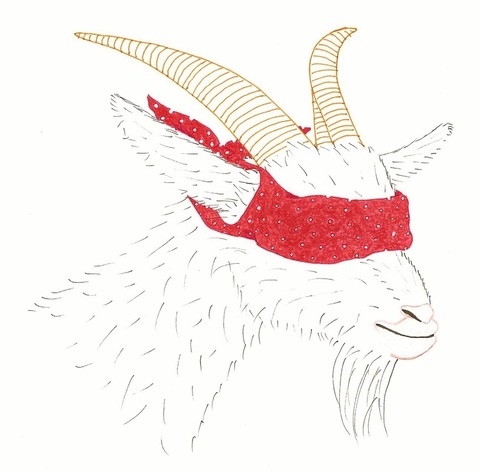
I prefer the name "Blind Goat" (Drawing by Me!)
      To my great surprise, I first discovered today that this game is NOT called "cobra-cega" (blind snake, in a literal translation) as I thought it was, but "cabra-cega" (blind goat). In English, however, it is known as Blind Man's Buff. How the hell did a goat got into the story to be present in the Portuguese name, God only knows.
    Anyway, this game was allegedly invented in 500 b.C., during the Zhou Dinasty in China. In the Middle Age and in the Victorian Era, it was considered an aristocratic amusement: the House of Tudor (which reigned over England between 1485 and 1603), used such games as an option for recreation.

                                                                                                                  . : .

    Oh, by the way, I know I haven't been posting many drawings or pictures made by me. That's because I've been very unorganized with my daily tasks, and not much time is left for me to draw or photograph something nice to put here. But I'll try my best to change it from now on, so stay tunned in 365 DOL!
~Ally
0 Comments

Day 77 -> How is a Tunnel built?

8/5/2013

0 Comments

 
 Imagem
A train tunnel (Photo from Tumblr)
      This past weekend I travelled to São Paulo and, along the way, crossed several tunnels. Which got my mother wondering: how does one builts transportation tunnels?
      Well, before there were tunnels, people used channels (artificial water passages) to navigate. These channels passed above the ground, just like our current roads and/or railways. However, some obstacles emerged along the path, like mountains, for example. In order to pass these great obstacles, the first tunnels were developed.
     How you built a tunnel depends on what material it has to go through: hard soil, soft soil, water (the most difficult environment to built tunnels in), hard rock, soft rock. Because of that, planning is a very important part of fabricating a tunnel successfully. The engineers make a complete geological analysis of the place to determine which kind of material will be found and to evaluate the risks of different possible places of construction. Many factors are considered, but the most important ones are: the types of soil and rock; the weak areas, including faults and shear zones; underground waters, including flow pattern and pressure; especial risks such as heat, gases and fault lines. Usually, a tunnel goes through more than one type of material, therefore facing different risks.
     The process of building a tunnel and advancing the excavation can be long and boring, requiring explosions, manual excavation and perfuration. The engineers often use two basic techniques to dig a tunnel: the full excavation method and the "top-heading-and-bench" method. In the first one, they dig the whole tunnel diameter at the same time. This is the most appropriate technique for tunnels that pass under strong soil or the ones that are smaller. In the second method, the workers dig a smaller tunnel to begin with, the driver tunnel. Once the driver enters a certain distance within the rock, the workers start to dig right under these upper driver's layer. This second tunnel is called berm. One advantage of this method is that the engineers can use the driver tunnel to measure the rock's stability before continuing the project.
     Finally, unless the tunnel is small, it is essential to provide safe work conditions and to guarantee the safety of travelers after the tunnel is put in operation. One of the most valuable concerns is ventilation, a problem which is almost always magnified by the gases released by trains and automobiles, but ventilators usually do the trick.
~Ally
0 Comments

Day 76 -> The One-Eyed Doe

8/4/2013

0 Comments

 
 Imagem
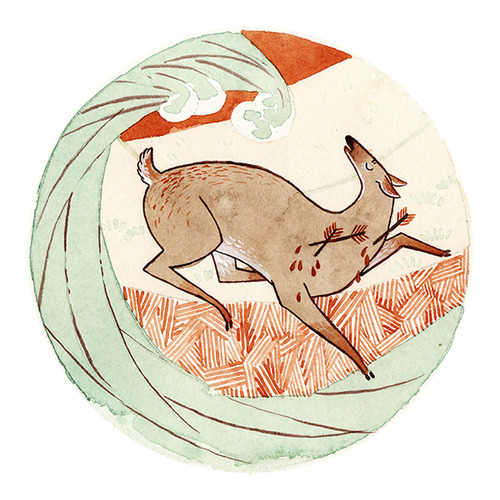
The One-Eyed Doe (Painting by Kailey Lang)
      "A Doe blind in one eye was accustomed to graze as near to the edge of the cliff as she possibly could, in the hope of securing her greater safety. She turned her sound eye towards the land that she might get the earliest tidings of the approach of hunter or hound, and her injured eye towards the sea, from whence she entertained no anticipation of danger. Some boatmen sailing by saw her, and taking a successful aim, mortally wounded her. Yielding up her last breath, she gasped forth this lament: 'O wretched creature that I am! to take such precaution against the land, and after all to find this seashore, to which I had come for safety, so much more perilous.'"
~Ally
0 Comments

Day 75 -> The Owl and the Birds

8/3/2013

0 Comments

 
 Imagem
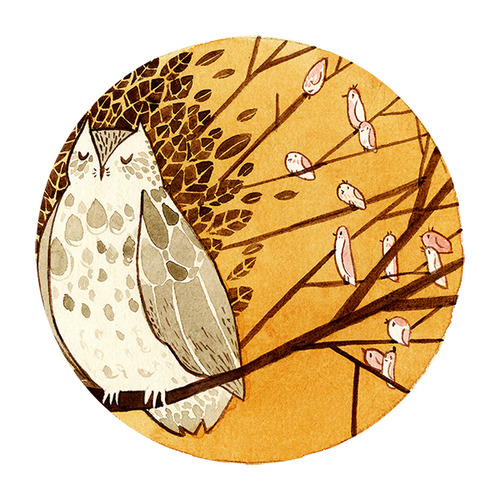
The Owl and the Birds (Painting by Kailey Lang)
      Another Aesop fable I didn't know... =)
     "An Owl, in her wisdom, counseled the Birds that when the acorn first began to sprout, to pull it all up out of the ground and not allow it to grow. She said acorns would produce mistletoe, from which an irremediable poison, the bird- lime, would be extracted and by which they would be captured. The Owl next advised them to pluck up the seed of the flax, which men had sown, as it was a plant which boded no good to them. And, lastly, the Owl, seeing an archer approach, predicted that this man, being on foot, would contrive darts armed with feathers which would fly faster than the wings of the Birds themselves. The Birds gave no credence to these warning words, but considered the Owl to be beside herself and said that she was mad. But afterwards, finding her words were true, they wondered at her knowledge and deemed her to be the wisest of birds. Hence it is that when she appears they look to her as knowing all things, while she no longer gives them advice, but in solitude laments their past folly"
~Ally
0 Comments

Day 74 -> The Ass and the Charger

8/2/2013

0 Comments

 
 Imagem
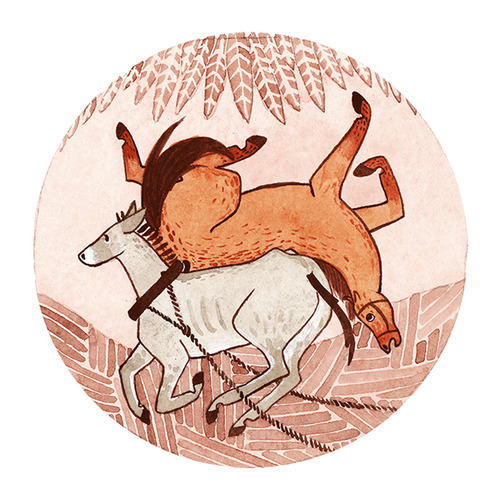
The Ass and the Charger (Painting by Kailey Lang)
      There's one Aesop fable I didn't know!
     "An ass congratulated a Horse on being so ungrudgingly and carefully provided for, while he himself had scarcely enough to eat and not even that without hard work. But when war broke out, a heavily armed soldier mounted the Horse, and riding him to the charge, rushed into the very midst of the enemy. The Horse was wounded and fell dead on the battlefield. Then the Ass, seeing all these things, changed his mind, and commiserated the Horse."
~Ally
0 Comments
<<Previous
Forward>>

    Author

     Ally is a Biologist, Illustrator, Photographer and ex-procrastinator.

    Categories

    Todos
    Art
    Astronomy
    Botanic
    Comics
    Curiosities
    Diy
    Documentaries
    Folklore
    Food
    Games
    Geography
    History
    Inspiration
    Literature
    Maps
    Movies
    Music
    Mythology
    Nature
    Physics
    Sports
    Weapons
    Zoology

    Archives

    Abril 2014
    Março 2014
    Fevereiro 2014
    Janeiro 2014
    Dezembro 2013
    Novembro 2013
    Outubro 2013
    Setembro 2013
    Agosto 2013
    Julho 2013
    Junho 2013
    Maio 2013

    RSS Feed


Powered by Create your own unique website with customizable templates.